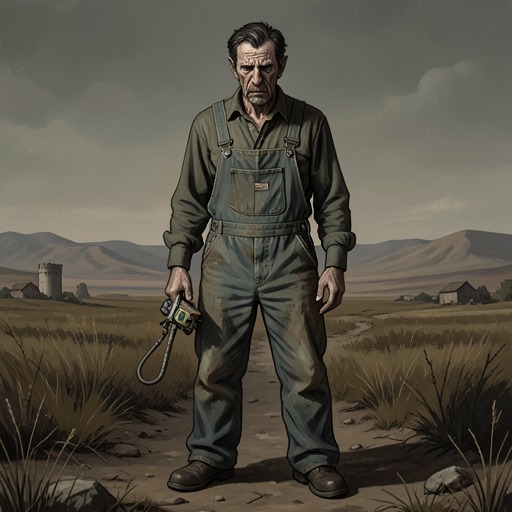
Tirin’s Satirical Play and Its Aftermath
The DispossessedTirin’s Satirical Play and Its Aftermath is a remembered episode in which Tirin’s comic performance of an Urrasti trying to live by ownership and commerce on Anarres becomes the occasion for his social rejection and eventual psychological ruin. The play makes property’s logic ridiculous; the response to it reveals how a society without formal property laws can still enforce conventional behavior through collective judgment.
The Play as Social Satire
At the Summer Festival, after Shevek had left, Tirin staged a play about an Urrasti who hides in a hydroponics tank aboard a Moon freighter, breathing through a straw and eating the plant roots, in order to be smuggled onto Anarres. Once there, he tries to buy goods at depots and sell them to people. He hoards gold nuggets until he has so many that he cannot move, then settles in place, builds a palace, and proclaims himself the Owner of Anarres. The absurd accumulation gives the property system a physical punchline: possession, pursued without limit, immobilizes the possessor.
The play’s sexual comedy extends the same satire into intimate life. Its Urrasti wants to copulate with a woman who is ready, but he cannot proceed until he has offered her gold nuggets as payment. She refuses them; he launches himself at her, then springs away as though bitten, insisting that he must not act because it is neither moral nor good business. The scene makes commercial exchange so absolute that it obstructs even an encounter that the other person freely welcomes. Takver remembers the play as silly but witty, and describes Tirin as marvelous in the Urrasti role: funny and vividly alive in performance.
From Performance to Rejection
Tirin’s circumstances had deteriorated by the time Shevek later met him in Elbow, where he worked as a mill janitor. Shevek asks whether he had chosen the job; Takver doubts that, by then, he was able to choose at all. She recalls that Bedap believed Tirin had been forced to go to Segvina Island and bullied into asking for therapy. Takver does not claim certainty about what happened there, and distinguishes the Asylum’s possible attempt to offer shelter from the social forces she believes broke him. When she saw Tirin several years after therapy, she found him destroyed.
In Shevek’s account, the play was the breaking point. Its reception included a moralistic scolding, and Tirin was denied a teaching posting. Shevek rejects the idea that the response could simply have been ignored: Tirin was already vulnerable, and the denunciation carried the force of an entire community’s disapproval. The decisive injury was not merely that a particular audience disliked a comedy, but that the judgment narrowed Tirin’s place in the society and left him with no clear ally.
Repetition and Fear
After his collapse, Tirin kept writing the same play. Every couple of decads he came to Shevek and showed it to him. Shevek would read it, or pretend to read it, and try to talk with him about it; Tirin desperately wanted that conversation but was too frightened to manage it. The repeated return of the play gives it a double meaning: once a lively public satire, it becomes the fixed work through which Tirin tries, unsuccessfully, to reopen communication.
Shevek identifies the object of Tirin’s fear as himself, everyone around him, and the social organism he had experienced as rejecting him. He explains that when a person feels alone against the rest of humanity, fear is an understandable response. Takver challenges the scale of this interpretation, suggesting that Tirin may have treated a few people’s condemnation as proof that everybody opposed him. Shevek’s answer is not that Tirin’s conclusion was literally accurate, but that the society offered him too little evidence of solidarity to counter it: his question is who, in fact, stood up for him.
Informal Coercion and the Meaning of the Ending
Shevek connects Tirin’s fate to a wider conflict between social conscience and individual conscience. In his view, people are ashamed to refuse a labor posting and fear being labeled lazy, dysfunctional, or self-indulgent; the pressure to obey a neighbor’s judgment can outweigh respect for freedom of choice. This is coercion without a written law or formal owner. The community marks a person as outside its approval, then treats the resulting isolation as that person’s fault.
For Shevek, Tirin’s refusal to build the invisible walls of conventional behavior made him a natural rebel and a genuine Odonian. He interprets the community’s response as punishment for Tirin’s first free act: society created the outcast and then condemned him as a criminal. Takver does not romanticize Tirin’s resilience; she says he was not strong, and Shevek agrees that he was extremely vulnerable. That vulnerability is essential to the episode’s force. The play’s comic image of an owner trapped by his gold is answered by the tragedy of a dissenter trapped by social judgment. Its aftermath tests the difference between a society’s professed freedom and the freedom its members can actually exercise without losing the support of their peers.